Arkiv, Høytlesning
Desert Fathers 50
You can find this episode in video format here – a dedicated page – and pick it up in audio wherever you listen to podcasts. On YouTube, the full range of episodes can be found here.
There was a man of venerable life: Benedict, blessed by grace and name, who from the time of his boyhood had the heart of an old man. For, surpassing his age by his behaviour, he gave his soul to no sensual pleasure, but, while still on this earth, he despised the world in its blossoming — which he could freely have enjoyed while it lasted — as if it were already withered. He was the offspring of a good family from the province of Nursia, and had been put to his studies at Rome. But when he saw that many in such studies went by way of the steep crags of vices, he pulled back the foot which he had, as it were, put on the world’s threshold, lest, if he touched any of the world’s knowledge, he too should afterwards wholly go over a great precipice. Despising, then, the study of letters, he left his father’s home and affairs, desiring to please God alone, and sought the habit which belongs to a holy way of life. He departed, therefore, knowingly unknowing and wisely untaught.
Antony’s biographer knew his subject personally. Benedict’s did not. He checked his sources, though, and was not a man given to carelessness. Gregory the Great wrote his life of Benedict while serving as pope. He says that, for research purposes, he consulted four men who had been Benedict’s pupils. He gives names and addresses. Readers might check his narrative if they pleased.
Gregory was seven, more or less, when Benedict died in 547. Their experiences overlapped. The world they lived in, to which they preached, was one and the same world, though it was changing.
Gregory introduces his hero with a lovely turn of phrase: ‘gratia Benedictus et nomine’. The Latin form of ‘Benedict’ means ‘blessed’, as when we sing at Mass: ‘Benedictus qui venit in nomine Domini’. Gregory says Benedict’s name carried a premonition of his being. The promise inherent in him from birth was realised by grace.
This statement contains a whole theology of vocation. For if God does call a woman or man to a given state of life, is it not because he, the all-knowing Maker of all, wishes to crown his work of creation and purpose it optimally? People sometimes think that the pursuit of a vocation involves great mortification. But no: if the call is God’s, you will, by following it, find joyful fulfilment. As you grow into it, it will seem to you like a tailor-made garment. It will make you flourish. It will set you free.
A sense of being trapped made the boy Benedict seek his path determinedly. He was, like Antony, well-to-do, used to a certain ease. A clever boy, he was sent off to study. He did not need to earn a living. When Benedict settled in Rome, it was not any more the navel of the world. Constantine had removed the imperial capital to Byzantium in 330. Even when, later, the Western Empire regained some autonomy, it was not run from Rome, but from Ravenna. The city Benedict knew breathed the decadence of capitals once great that drift, despite themselves, like history’s flotsam, into backwaters. A certain grandeur will have remained, but the civic body was pockmarked. There were people nurturing virtue and learning; yet what struck Benedict most was urban vice. He saw how vice can acquire a momentum that draws people into self-destruction, causing them perversely to throw themselves off cliffs.
This was a fate he did not wish for himself. Withdrawing the foot he had tentatively placed on the threshold of secular life, he went into the woods. Benedict was no bore. It was not exuberance that repelled him. His view of human nature, he later showed, was not only fearless, but compassionate. What irked him in the world was the nurtured illusion that what blooms today will not have to whither tomorrow.
He had, Gregory writes, the heart of an old man already in his youth. What might that mean? It means, I think, that Benedict, like the Preacher in Ecclesiastes, could see that all is vanity when not held by some supernatural purpose. He saw ‘The invisible worm, / That flies in the night / In the howling storm’ to make the rose sick. He could delight in the rose; but could not force himself to pretend that it would flourish for ever. Longing for lasting things, he wished ‘to please God alone’, thereby to seek his own joy. Quite as James and John, one early morning by the sea, left Zebedee’s nets, Benedict abandoned his father’s home and affairs, with the security they offered and the culture they presupposed, to live otherwise.
Gregory describes his state of mind subtly. He calls Benedict ‘knowingly unknowing and wisely untaught’. To know what is not worth knowing, or what does not further my maturing right now, may have been a considerable challenge in Benedict’s day. Now it is Gargantuan. Bombarded from all sides with information, true and false, we are terrified of missing out.
Benedict’s example gives wholesome encouragement. It stands for a critical view of the turbulent, unsleeping city, of its rat-races and pleasure-hunts, inviting us to ask: Is this really what I want? Benedict could evaluate these things justly because he had the beginnings of wisdom, or, if you like, of philosophy. Untaught by conventions, he was open to fresh inspiration from on high. Faced with the world and its options, he did not just calculate. He prayed. And so got the courage he needed to choose independently, freely.
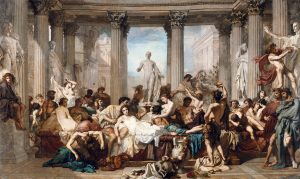
The Romans in their Decadence by Thomas Couture. Wikimedia Commons.
.jpg)