Archive, Readings
Desert Fathers 52
You can find this episode in audio wherever you listen to podcasts. On YouTube, the full range of episodes can be found here.
Benedict, the man of the Lord, while the brethren were still taking their rest, was zealously keeping vigil. He had anticipated the time of the night prayer. As he stood at the window and prayed to the almighty Lord, suddenly, looking out in the dead of night, he saw that light poured from above had put to flight all the night’s darkness, and it shone with such splendour that that light, which had shed its radiance amidst the darkness, surpassed the day. But a very marvellous thing followed as he looked upon this, for (as he himself told it later), the whole world too was brought before his eyes, as if gathered under one ray of the sun.
For three years Benedict lived in solitude. His life’s task, though, was the founding of communities, even of an order. He acquired his first experience when some monks near Subiaco chose him, freshly emerged from his cave, as superior. They regretted it, finding 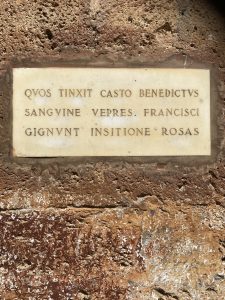 Benedict too strict. He returned to his cave to ‘live alone with himself’. But when keen disciples gathered round him, he took them to Montecassino, moving from the bowels of the earth onto a hilltop, like the lamp taken from underneath the bed to be placed on the lamp-stand. He poured himself out for his brethren.
Gregory tells us of his spiritual paternity. Benedict’s own rule enshrined it. Writing it, he left to posterity a code that permitted replication of a well-tried, sane form of life. The result was a civilising movement. It humanised Europe and made deserts bloom.
Benedict was graced with gifts of prophecy. Not only was he, like other holy ascetics, able to read people’s hearts; he could see the present in the light of the future. His seeing is a recurrent motif in his biography; even as, in his Rule, he often urges us to learn to see, and to be seen. Two particular visions marked his life and consciousness especially.
The first of these he confided to a friend, a layman called Theoprobus, who turned up one day, as was his habit, to see Benedict in his cell. Theoprobus was surprised to see the normally serene, even-tempered abbot in tears. He asked what had happened. Benedict explained. He had just had a glimpse of the future which terrified him: ‘All this monastery which I have built, and everything that I have prepared for the brethren, has by the judgement of almighty God been handed over to barbarians. And I have only barely been able to obtain the concession that those who will then be living in this place will survive.’ Tradition has recognised the fulfilment of this prophecy in the destruction of Montecassino by Lombard forces in 589, only 42 years after Benedict’s death. He spent much of his life building up something he knew would soon be pulled down. Did that discourage him? Not the slightest bit. His mindset was not that of a prognosticating marketing consultant or an insurance broker. His aim was to offer his existence as a sacrifice of praise to the Lord, sparing nothing. In such priestly worship calculation has no place: the offering risked must be entire, a holocaust. It is good to be recalled to this imperative.
Benedict’s second crucial vision makes sense of his response to the first. But it came decades later. The chronology matters. He had to live long in darkness of faith with prospects of destruction. Only when faith had been through this crucible was it confirmed by vision. Benedict was old then. Night had fallen. The monks had gone to bed. He kept vigil, climbing up into a tower, the highest point of the monastic complex. When one has been to Montecassino one understands this wish to move up. The monastery sits atop a hill in the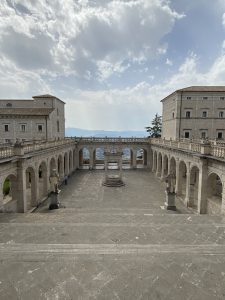 Lazio plain. At 516 metres, it is not very high, but climatic conditions produce a remarkable effect. When you step out of the abbey church in the morning after vigils, mist covers the landscape below. You have the exhilarating sense of being suspended in the air. The piazza in front of the church is fittingly called Loggia del Paradiso. At night, likewise, heaven seems close, as if the abbey were the end of Jacob’s Ladder. Benedict had climbed to the highest rung. Looking out, ‘suddenly, in the dead of night, he saw that light poured out from above had put night’s darkness to flight. It shone with such splendour that that light […] surpassed the day. A marvellous thing ensued as he looked on this, for the whole world was brought before his eyes, as if gathered under one ray of the sun’.
Oh to see the world in such a way, its complexity, vastness, and apparent contradictions embraced by the purifying light of God’s redemptive love!
Benedict’s faithful, loving life had prepared him for this sight; he was ready to enter the reality it foreshowed. Shortly afterwards he gave up the ghost, his arms raised high in prayer, supported by his brethren, the way we see the scene depicted in sacred art. What makes St Benedict the Father of the West is not primarily the work Benedictines have wrought in learning, hospitality, liturgy, agriculture, and the arts. This work is wondrous, worthy of high esteem. But the source of St Benedict’s enduring fecundity lies elsewhere. It springs from his resolve to put nothing at all before Christ’s love. Like Antony, he could say that Christ was the air he breathed. He shows forth human nature renewed in Christ. That is what matters. Nothing else.