Archive, Readings
Desert Fathers 49
You can find this episode in video format here – a dedicated page – and pick it up in audio wherever you listen to podcasts. On YouTube, the full range of episodes can be found here.
The reason we have written this rule is that, by observing it in monasteries, we can show that we have some degree of virtue and the beginnings of monastic life. But for anyone hastening on to the perfection of monastic life, there are the teachings of the holy Fathers, the observance of which will lead him to the very heights of perfection. What page, what passage of the inspired books of the Old and New Testaments is not the truest of guides for human life? What book of the holy Catholic Fathers does not resoundingly summon us along the true way to reach the Creator? […] Are you hastening towards your heavenly home? Then with Christ’s help, keep this little rule that we have written for beginners. After that, you can set out for the loftier summits of the teachings and virtues we mentioned above, and under God’s protection you will reach them. Amen.
Throughout this series I have referred to the teaching of St Benedict. The time has come to speak of him specifically. Benedictine monasticism has shaped the West. Not for nothing did Pope St John Paul II in 1980 proclaim St Benedict a patron of Europe. When we think of Benedict’s legacy we may think first of imposing buildings, venerable institutions, Gregorian chant, and thick, learned, leather-bound tomes. St Benedict seems to represents the settled solidity our world today has largely lost. So we may assume that his mindset was different from that of the Desert Fathers whose humble cells were provisional, who set up no schools, who prayed in private, and were more concerned with giving books away than with gathering them in libraries.
Of course, there are distinctions. Benedict was a Roman through and through. He excelled in organisation and expressed himself in lapidary prose. His was a world of forests and broad fertile plains dotted with villas. A desert of sand he could only have imagined. Benedict was by character discreet. His governance was exquisitely balanced. It is hard to fancy him giving the sort of counsel Antony gave when, to teach a man detachment, he sent him out among birds of prey and wild dogs covered in bacon. Let us not, though, make too much of these external features. Inwardly Benedict stood in grateful continuity with those monks who had lived and fought in Egypt. If you have studied the lives and sayings of the Desert Fathers in depth, then turn to the Regula and Life of Benedict, you will pick up countless resonances. Should your ear not yet be sufficiently attuned, turn to the index pages of a critical edition of the Rule and you will see the frequency and range of its author’s references.
Let us not forget that monastic life became highly organised in Egypt as well. Already in Antony’s day, colonies were set up so that Athanasius, travelling inland from his see of Alexandria, could note: ‘there were in the mountains monastic dwellings like tents filled with heavenly choirs, singing Psalms, rejoicing in the hope of things to come, working to give alms, having love for each other and being in harmony with one another. To see it was truly to see a land like no other.’
What Antony’s spiritual descendants built was a new civilisation. Athanasius saw it and was glad. St Pachomius, born a generation later, took the task of establishing monasticism further. He brought monks together in fixed, intentional communities. At the command of an angel, Pachomius composed a monastic rule destined to have great influence. St Basil read it and used it in his ordinances. St Jerome translated it into Latin. In these ways it came to nourish St Benedict as well.
By the time Pachomius died in 348, his community had well over a hundred members. It would be wrong, therefore, to entertain the idea, a caricature, that Egyptian monasticism stayed somehow primitively pure, charismatic, and personal while in Europe it was shackled by institutions. To the south as well as to the north of the Mediterranean Basin, wise women and men worked hard to pass on and perpetuate the fire that the likes of Antony, Macarius, and Moses had lighted in many human hearts. Any charism, to last, must eventually find objective expression in a framework of sharable stability. There is no inevitable contradiction between rule and life. The challenge is to maintain the rule infused with life, and to regulate vitality.
The passage cited above is from the last chapter of Benedict’s Rule. Summing up his teaching, it provides a list of Further Reading. Benedict’s project continues that of the earlier Fathers. He distils their insights. What he modestly calls a little rule for beginners is in fact pure essence. Any monk or nun who has read it and sought to put it into practice will testify to this. Even more so will abbots or abbesses who, over time, have taught the rule to their communities, discovering what depths exist under surfaces of seeming simplicity. Benedict, too, incites us to set our sight high, to aim for ‘perfection’ in the sense I developed in the first few episodes. The wisdom of the Desert Fathers is not confined to the past, or to books. It is alive, a generator of good zeal, in countless monasteries now. Their continued flourishing is crucial to the ecosystem of the Church’s life. We may hope that generous, courageous women and men , thirsty for fullness of life, will answer the monastic call still.
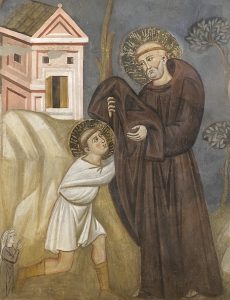
St Benedict being clothed in the monastic habit. Fresco from the church of Subiaco.