Words on the Word
Communion
Homily given as part of an Advent recollection at the Dominican church in Kraków following the launch of the Polish version of my book Chastity.
Jesus reached the shores of the Sea of Galilee, and he went up into the hills. He sat there, and large crowds came to him bringing the lame, the crippled, the blind, the dumb and many others; these they put down at his feet, and he cured them. The crowds were astonished to see the dumb speaking, the cripples whole again, the lame walking and the blind with their sight, and they praised the God of Israel. But Jesus called his disciples to him and said, ‘I feel sorry for all these people; they have been with me for three days now and have nothing to eat. I do not want to send them off hungry, they might collapse on the way. Matthew 15 29-37.
There is an aspect of Christ’s life we tend to erase, abetted by exegetical and artistic tradition: the fact that he, as the Gospels present 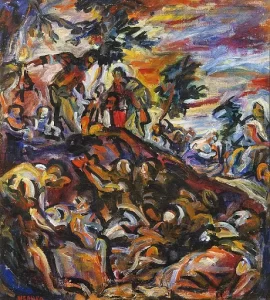 him, is almost always surrounded by a motley, unruly, demanding crowd of people.
Those who seek to get to know Jesus nowadays, to commune with him in prayer, are often anxious to ensure they have peace, solitude, and a predictable life. We easily think that prayer can only be found in some rural monastery or retreat house. It is good, by all means, to go to such places now and then to rest.
Christ himself bade his disciples rest — but he did immediately add: ‘for a while’ (Mk 6.31). The implication is clear: they’re afterwards to come back to the fray, for there, too, God can be found, worshipped, and beautifully served.
Today’s Gospel shows us Jesus assailed by ‘the lame, the crippled, the blind, the dumb, and many others’, that is to say, by people like us. The disciples are inclined to shoo them away: ‘Let them go and get themselves supper!’
Jesus, meanwhile, is concerned to console and feed them, moved by compassion for their need. This concern brings about the multiplication of loaves and fishes, a miracle foreshadowing the Eucharist. It shows how a little, once it is blessed and given in love, can go a long way.
The saint we commemorate, St Francis Xavier, was a man driven by Christlike compassion, wholly surrendered to his mission. In a letter to his friend Ignatius he speaks of how, on a mission to India, children ‘would not let [him] say [his] Office or eat or sleep’, wanting his attention, demanding to be instructed and fed. Like his divine Master, Francis gave himself over to the people who needed him in this way. Thus he became a shining example, not only of Christian virtue, but of Christian prayer. 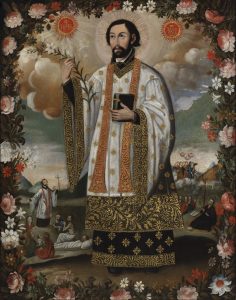
During Advent we pray, again and again, ‘Come, Lord, do not delay!’ Our eyes are raised heavenward. Let us make sure we also look closely round about. For the Lord comes to us not just in sublime, spiritual realities; he comes no less in the ragged, the poor, the lonely. On the day of judgement, he will tell us (we have it on his authority): ‘Whatever you did not do to one of the least of these, you did it not to me.’
It is wholesome to nurture our spiritual lives in private; it is good, at times, to be quiet and at ease. Let us never forget, though, that the Lord whom we await says of himself, ‘My Father is always at work, and I too am working’.
The unruffled communion of the Blessed Trinity is not disturbed by constant engagement in the work of redemption and the fulfilment of history. On the contrary: these works are the natural expression and effluence of divine communion in charity.
‘The consolations of God’, wrote St Francis Xavier from Travancore in 1545, ‘are so great that they make all troubles sweet.’ That sweetness is what we seek. By living as Christ lived, we shall find it.
Amen.