Words on the Word
Not Worthy
Homily given as part of an Advent recollection at the Dominican church in Kraków following the launch of the Polish version of my book Chastity.
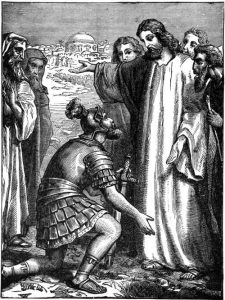
When Jesus went into Capernaum a centurion came up and pleaded with him. ‘Sir,’ he said ‘my servant is lying at home paralysed, and in great pain.’ ‘I will come myself and cure him’ said Jesus. The centurion replied, ‘Sir, I am not worthy to have you under my roof; just give the word and my servant will be cured. For I am under authority myself, and have soldiers under me; and I say to one man: Go, and he goes; to another: Come here, and he comes; to my servant: Do this, and he does it.’ When Jesus heard this he was astonished and said to those following him, ‘I tell you solemnly, nowhere in Israel have I found faith like this. And I tell you that many will come from east and west to take their places with Abraham and Isaac and Jacob at the feast in the kingdom of heaven. Matthew 8.5-11.
This encounter of our Lord with the centurion is intimate to us. Each day, before Holy Communion, we repeat the officer’s words: ‘Lord, I am not worthy that you should enter under my roof!’ The meaning of the words in the Gospel seems self-evident.
Let us note, though, this this humble confession is made in response to Jesus’s benevolence. When the Lord hears of the paralysed servant, he does not hesitate, but says at once: ‘I will come myself’. Unconditional kindness prompts the centurion’s self-reflection. After all, he had not come disinterestedly. He carried a request, expected assistance. He was a military man of might. Jesus’s kindness disarms him.
If at times we find people we deal with lacking in humility, we might well examine ourselves in the light of this scenario. Does humble generosity on my part call it forth in others? Or is harshness I encounter a reflection of my own hard heart?
Jesus does not go to the centurion’s house, but sends him home with the word: ‘Go, be it done for you as you have believed.’ We are told that the servant ‘was healed at that very moment’. A visitation did, then, take place nonetheless. For God is in his word. And a word gone forth from his mouth does not return to him empty (Isa 55.11).
There is another aspect to consider. Jesus enters not under the centurion’s roof, but welcomes the centurion under his. We have heard how Isaiah, in a wonderful prophecy, says that ‘the glory of the Lord will be a canopy and a tent to give shade by day from the heat, refuge and shelter from the storm and the rain.’
God’s glorious mercy manifest in Jesus is for us this canopy. The centurion found respite underneath it, and immense spaciousness. It matters to keep this incident in mind when later in the Gospel we hear Jesus say, ‘I was sent only to the lost sheep of the house of Israel’ (Mt 15.24). By his actions he had already broadened the scope of this mission, inviting us always to interpret what he says in the light of what he does.
So how can we best make our own confession, at this Mass: ‘Lord, I am not worthy that you should enter under my roof!’? By recognising the immensity of God’s grace and our own limited graciousness; by acknowledging frankly aspects of our life that need repair; while daring to whisper nonetheless: ‘Yes, there is quite a mess under my roof, but enter anyway’. Then by resolving to get up and move without delay when the Lord summons us under his roof, there to find comfort, nourishment and strength, grace to live by and to share, that others may live. Amen.