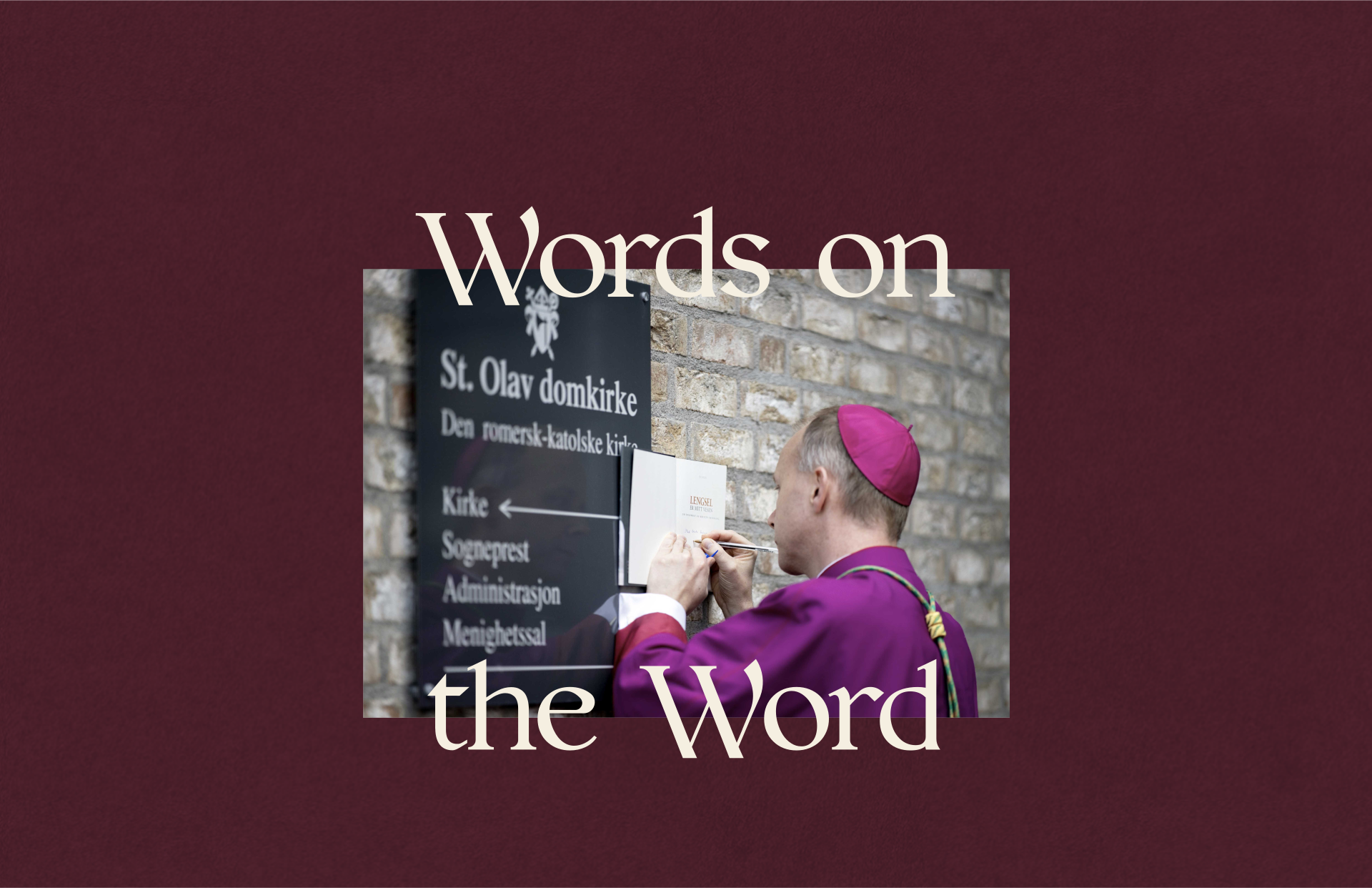
Here I have put together a selection of homilies. The Word of God is ‘alive and active’ says the Letter to the Hebrews. That is not to say that it lives a hidden organic life we can trace through a microscope, as if it were a virus; but that it is inspired, a bearer of God’s eternal Spirit. Therefore it resounds to this day with quite as much force as when it was first spoken. It ever has something new to say. The preacher’s first task is to listen intently to this Word at once ancient and new, then to make his own, necessarily limited words its vehicles. I have not been able to provide translations of texts in other languages; but if you rummage around a little you will find a fair amount of material in English.
Tenker vi oss raskt gjennom Bibelen, finner vi at Guds venner preges av ledig og energisk bevegelse. Da englene gjestet Abraham, sprang hans som en guttunge for å gjøre alt rede, enda han nesten var hundre år gammel; da Elija, som i yngre år satt og furtet under en gyvelbusk, var kommet til veis ende, fòr han til himmels i et uvær; da Maria etter engelens budskap var blitt Ordets tabernakel, skyndte hun seg med en gang over fjellene for å bistå Elisabeth.
Continue reading Døden var ikke fra opphavet av, den er fremmed for vår egentlige menneskenatur, slik vi i blant opplever det spontant og vet det med maven. I dag minnes vi at vi er del av et dødsoverskridende fellesskap.
Continue reading Å være cistercienser, er å rotfestes i det reelle. Vår Orden har kjent lysende mystikere, bevares; dog synes meg normen snarere en utdyping av nattlig tro, en hvetekornserfaring.
Continue reading Å være kristen, er å bekjenne at man ikke er autonom; ja, at man slett ikke ønsker å bli det; ikke fordi man er feig, men fordi man gjennomskuer autonomien som noe illusorisk. For oss som kristne, er det å leve “på nåde” rett og slett en oppsummering av livet slik det faktisk er.
Continue reading En nous donnant comme première lecture pour cette veille de l’Assomption le récit de la montée de l’Arche à la ville de David, l’Écriture met devant nos yeux un magnifique symbole théologique. L’Arche de l’alliance, c’est la Bienheureuse Vierge Marie qui porta dans son sein le Dieu trois fois saint; l’Assomption signifie son entrée définitive dans la Jérusalem céleste parmi les cris d’exultation d’innombrables légions d’anges.
Continue reading Dieu, notre Créateur et Père, n’hésite pas d’entamer une déconstruction radicale pour, ensuite, pouvoir rebâtir. Pour le dire autrement: le vieil homme doit mourir et céder la place à l’homme nouveau.
Continue reading Saint Pierre Chrysologue, ‘de la parole d’or’, le grand évêque de Ravenne que l’Église commémore aujourd’hui, dit magnifiquement dans un de ses sermons: Homo, quare tibi tam vilis es, qui tam pretiosus es Deo?
Continue reading Marie Madeleine est la preuve qu’aucun obstacle, aucune chose vécue ou subie, puisse nous séparer de l’amour vivifiant du Christ. Nous n’avons qu’à combattre la tendance perverse qui nous habite, le fruit du péché: la tendance à dire Non, à refuser la grâce, à préférer librement la mort à la vie.
Continue reading J’ai connu un vieux moine, un homme lumineux, dont la prière après 70 ans de vie monastique s’était distillée en deux phrases, ‘Saint Esprit mon ami, Saint Esprit mon amour!’ Il les répétait inlassablement, jour et nuit.
Continue reading L’évangile de ce jour, plein de détails pittoresques, de beaux vieillards et de tourterelles roucoulantes, suppose un arrière-fond mystérieux et par conséquence ténébreux, car le mystère appartient au pénombre, ayant besoin du lever du Soleil de Justice pour éclore et manifester la lumière cachée en lui.
Continue reading Un’occhiata data ai giornali basta per farcelo costatare: le tenebre che, nei giorni d’Isaia, ricoprissero la terra non sono svanite. La domanda si pone: come credere in una bontà salvificamente luminosa in un mondo rimasto buio?
Continue reading The first recorded instance of public preaching in the Catholic Church was thought by onlookers to be a display of drunkenness. It is a point worth thinking about.
Continue reading We learn that from the outset of our faith, the Church has had to deal with infidelity; it has done so realistically, in faith, facing facts, sure that the Lord will provide. In our times, we have been reminded more than once that election to high ecclesiastical office is not in itself a guarantee of truthful living.
Continue reading Few spiritual tendencies are deadlier, more barren, more boring than the desire just to do better than someone else, be it the monastery across the valley or the brother or sister next to me in choir. Any reform movement, be it the micro-enterprise of reforming my own life, must exercise caution in this respect.
Continue reading The gloriousness of Christian existence was central to the thought of our father St Bernard, who spoke of it often, stressing all the while that it does not make for an easy life. For this glory, he once wrote, ‘is a secret glory, it lies hidden in tribulation’.
Continue reading Inch by inch, discourse that supposes the existence, the mere possibility, of truth is pushed out of the public arena: ‘What is truth?’ Give us instead Barabbas, a fine fellow made of the same stuff as ourselves!
Continue reading We live in times that are quick to anger, poor in steadfast love, that love to point the finger and accuse, whose mindset is litigious. God knows there is enough malfunction in the Church, in society; but what if, instead of declaring others’ guilt, we assumed a portion of its weight?
Continue reading Let us note this: the liturgy does not explain the massacre of Bethlehem: How could it? Quite simply, the Church ascertains that, yes, this awful thing did happen.
Continue reading The cry for pity will resound until the end of the world, when Christ returns with glory to judge the living and the dead, to ‘save those who are eagerly waiting for him’. Our great task as Christians is to position ourselves within this dynamic of expiation, intercession, and impending judgement.
Continue reading Most of us, if we look closely, are likely to recognise something of ourselves some of the items on the Lord’s list: ‘fornication, theft, murder, adultery, avarice, malice, deceit, indecency, envy, slander, pride, folly’.
Continue reading I often think of Augustine on his deathbed in 430, when Hippo was surrounded by vandals and he had his room covered with hangings that bore inscriptions of the Penitential Psalms: he wished to keep these ever before his eyes. He was conscious of living at the end of an age, awaiting the beginning of another, yet he remained, as far as we can see, largely free of fear and full of hope.
Continue reading Given the crises the Church has to negotiate right now, the Gospel's woe to hypocrites is not a vain statement. Hypocrites are people resigned to a discontinuity between what they say and what they do.
Continue reading Som gutt sadlet adelsmannen Olav bukken for sin stefar Sigurd Syr; han var seg sin stand bevisst. Hans misjonsstrategi bar nok også preg av at han syntes en tro som var god nok for ham, jamen burde være det for hans undersåtter også.
Continue reading When the Lord called the sons of Zebedee to follow him, they had no idea where he would lead them; they hardly knew who he was. They simply sensed that he knew where they needed to go, and that was enough.
Continue reading