Words on the Word
Requiem for Priests
2 Macabees 6,18–31: Eleazar, one of the foremost teachers of the Law, a man advanced in years and of beautiful countenance, was being forced to open his mouth wide to swallow pig’s flesh.
Luke 19,1–10: «Zaccaheus, today I must stay at your house.»
It’s November. We pray for the dead. Tonight we celebrate a Requiem for the deceased priests of the prelature.
The lectionary lets us read the story of Eleazar from the Second Book of Maccabees.
It unfolds in the 170s BC. The Holy Land is a colony of the Seleucid Empire, heir to that of Alexander. At its head is Antiochus Epiphanes, an ambitious, rabid enemy of the God of Israel. Antiochus set about systematically imposing idol worship on the people. He would have none of the inheritance of Patriarchs and Prophets. He would eliminate remembrance of the Covenant. Nothing was to nurture devotion to the one true God, based on the commandment: ‘Thou shalt have no other gods before me’.
This tendency is typical of totalitarian regimes that lack an ethical foundation. To such, set on exalting themselves to absolute status, the mere thought of Israel, the people of God’s promise that reminds the world, by its mere presence, that any human, bureaucratic policy must be tried in the light of a divine standard, is odious.
Not every believer is a hero face to face with such a campaign. If one is made to fall, to bend the knee to the king as if he were god, many others, too, are gained. One compromised conscience makes others fall, like domino pieces.
But if one resists! Then the pretensions of power are unmasked.
Eleazar possesses the needed resolve. He, a man over ninety, is not concerned just to save his skin. He would not let his weakness become a stumbling block to others. So he gives his life without histrionic gestures. He thinks about the young, he says. He would like to give them an example of what life is about, and ‘of how to make a good death, eagerly and generously, for the venerable and holy laws’.
This learned old man resisted royal might. He prevailed, though he lost his life. Remembrance of his fidelity gave others strength to live faithfully.
We count, as far as I know, no martyrs among the priests who have served in the prelature of Trondheim. Few of them are idealisable; they had, like most people, their curiosities and eccentricities. Many amusing stories are told about them. When with my inner eye I look out over the assembly of these God-given men, however, when I behold those who laid the foundation for the many good things we enjoy today, what I see first of all is fidelity and perseverance. In some I see an image of that ‘very beautiful countenance’ ascribed to Eleazar, a sign that grace has found a physical foothold.
Our priests give their lives that others might live. They proclaimed the fullness of faith. The made it possible for Christ to be bodily present here up north, so that the sanctuary light might burn in our churches, a source of comfort and strength, especially when storm winds raged outside. It is an excellent thing to have a good intention. The substances of an intention, though, is tested by time. Many of the priests who laboured here could have lived more visible, more publicly appreciated, more apparently successful lives elsewhere; but they chose a hidden, often austere existence as weather-beaten shepherds of a little flock because the Lord in his wondrous providence had called them here.
We remember them with gratitude and reverence. May the Lord give them a rich reward for their endeavour and raise them up to life eternal! And may he grant us grace to be faithful to the lot God entrusts to us, for the glory of his name and the world’s salvation.
May our good priests rest in peace! Amen.
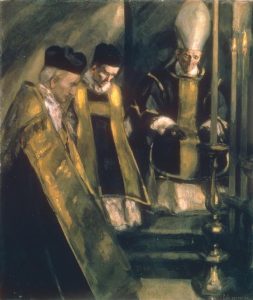
Requiem by Louis Charles Crespin